

A chatterbox cat with ears held high! That sums up the Serengeti better than anything. But let’s fill in the picture. So what is one of the rarest cat breeds in the world really like?
History of the Breed
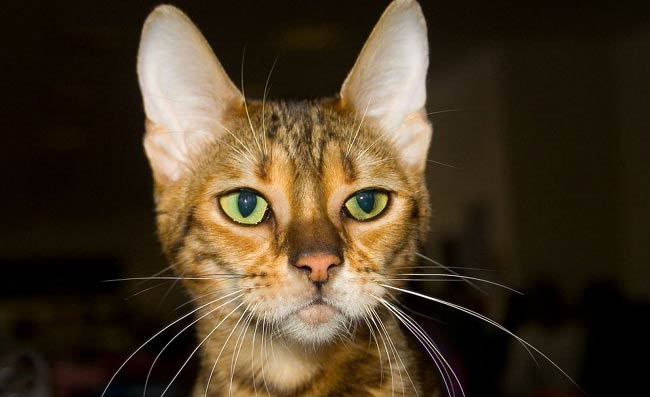
There are only a few hundred Serengetis in the world, and every one of them is picture-perfect, beautiful and charming! No surprise, since the Serengeti was developed precisely so people could enjoy wild African grace and beauty in a house cat.
But the Serengeti’s homeland isn’t the hot African continent; it’s the United States. In the 1990s, breeder Karen Sausman, who headed a wildlife park in California, was captivated by the serval. She set out to recreate the serval’s look in a domestic cat, on one condition: no servals would be used in the breeding.
The first cross was between a spotted Oriental Shorthair and a Bengal. These weren’t random cats. Karen Sausman carefully selected the genetic material and screened every candidate with ultrasound for disease.
Four years of careful preparation paid off. Today the Serengeti is not only one of the rarest breeds in the world but also one of the most sought-after. The breed still isn’t bred on a large scale: only a few dozen dedicated breeders work with it. A few dozen on the entire planet!
Breed Description

A big wild cat and an affectionate house cat produced wonderful offspring. Their lack of aggression and predatory look win everyone over. Without a trace of serval in their genes, these cats turned out to look remarkably like servals.
- The Serengeti has a flat, wedge-shaped head. The outline is smooth rather than sharp, with soft curves. The chin is strong but not massive, and the cheeks shouldn’t be prominent:
- the ears sit high on the head. They’re large and always “alert,” set high. The ears are as tall as the head; their alert set and large size are hallmarks of the breed;
- the eyes are set wide apart. They’re large, round and honey-colored, though the standard also allows other shades of gold, as well as hazel or light green;
- the nose is broad, and stays broad along its whole length. The nose leather is always dark and the whiskers are long;
- the neck is long and tall, widening from the head to the shoulders.
- From their first weeks, Serengeti kittens already show the breed’s signature elegance and muscle!
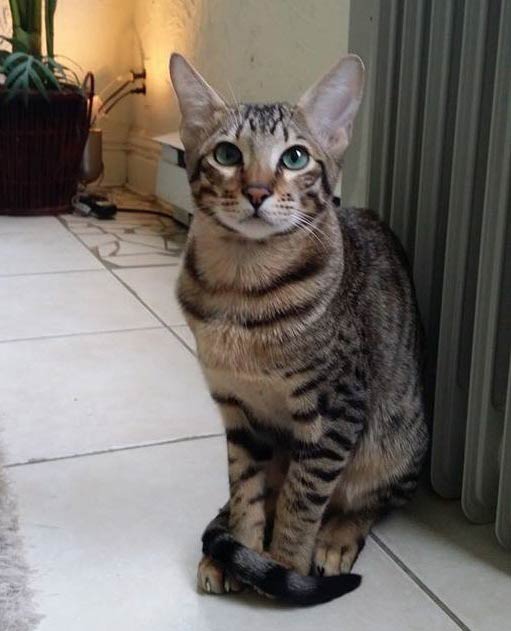
- the ideal Serengeti is medium-sized, with an athletic, sturdy semi-foreign build. Breed traits include a straight back, hips and shoulders of equal width, and a slightly long body. The muscles aren’t overdeveloped. Males are clearly larger than females;
- the legs are long and strong. The Serengeti has some of the longest legs of any domestic cat. The paws aren’t large and are oval;
- the tail is never overly long, but it can be thick. The tip is always black.

Females usually weigh about 8–12 lb, and males about 10–15 lb.
- Another difference from other domestic breeds is the coat. Serengetis have virtually no undercoat, and none of the usual “ruff” or “britches.” The coat is short, fine and very pleasant to the touch!
The standard allows several colors:
- black spotted tabby (contrasting spots);
- solid black (ghost spots);
- smoke (ghost spots).
Spots should always be round or slightly elongated, but only horizontally. A dark line running from the inner corners of the eyes is welcome. Color faults include the typical house-cat white, red and patched colors, and vertically elongated spots.
Personality

The Serengeti is a chatterbox. Oh, did we mention that already? Well, don’t say we didn’t warn you! Talkativeness and predatory grace are the breed’s hallmarks. They follow their owner around, purring, muttering, chirping and trilling; their vocabulary is huge. The chatter can get tiring at times, but you’ll never convince this cat to be quiet!
The Serengeti is also very stubborn. If it wants something, there’s no point locking that “something” away in the farthest room. As soon as you leave, the Serengeti will get past every barrier, and that “something” will end up in its muscular paws. To keep it away from your valuables, give it plenty of toys.
These cats are fearless. Descendants of proud wild animals, they aren’t afraid of stray dogs or even the chupacabra. Faced with either, a Serengeti will most likely choose “the best defense is a good offense”! Yes, this cat has a fighting spirit, so don’t let it roam outdoors alone: it might meet an opponent that’s more than it can handle.
The Serengeti is also a natural leader. In the home, the Serengeti is the boss. That’s rule number one. If anyone disagrees, they can reread rule number one or face the consequences! Those who accept its leadership are granted its highest favor: tenderness and affection.
Health

Urinary stones (urolithiasis) are the condition Serengetis are prone to. How can you catch it early? First, know that urinary blockages are much less common in females than in males. Second, early signs are almost impossible to spot. The problem often appears suddenly:
- the cat strains in the litter box for a long time;
- licks its genital area and cries pitifully;
- suddenly urinates in the wrong places, and so on.
Don’t try to treat it yourself; only a vet can handle the problem, and a male cat that can’t urinate is an emergency. Your vet can also advise on a diet that helps prevent it.
Otherwise, Serengetis are cats of excellent health. The way a Serengeti looks says a lot about how it feels. Tails up, cats, full speed ahead!
IMPORTANT! Serengetis should not be crossed with servals or other wild cats. Kittens from such litters won’t look like the breed or may be sterile.
The Serengeti lives about 10–15 years.
Care and Living Conditions
Caring for a Serengeti is no trouble at all. They need space and a little of your attention. Brush the coat now and then, wipe the eyes and ears, and that’s about it. Oh, right: also pet it. And talk to it!
Feeding
Cheap commercial food (especially dry) is out. Premium food only, no compromises! Seriously, though, a high-quality diet from the start is best for this cat. Then again, once you learn what a Serengeti costs, nobody would be surprised if it had its own nutritionist. And a chef. And a barista.
Pork is strictly off-limits. Also don’t offer milk or saltwater fish. If you add fresh meat, lean veal and beef are a good base for this exotic beauty’s daily menu, as long as the overall diet stays complete and balanced.
Photos

Even in photos you can see that Serengetis have some of the longest legs of all house cats. And they can jump up to about 6.5 feet high!
Where to Buy a Kitten

If only a few dozen people in the world can call themselves Serengeti breeders, it’s clear that “Where can I buy one?” is a hard question to answer. Some catteries offer Serengeti kittens only occasionally. If you care about the breed’s roots, Karen Sausman’s California cattery, Kingsmark, has had the best reputation. Owners say her cats are the best because she never mass-produces kittens.
In the US, a Serengeti kitten typically costs about $600–2,000, depending on the breeder, the kitten’s quality and its age. You’d agree that’s a fair price for a rare domestic “African cheetah”?
Catteries
TICA is the only major registry that recognizes the Serengeti, and there are very few breeders in North America, so expect a waiting list:
- TICA breeder listings: choose “Serengeti”;
- TICA Serengeti breed page: the standard and breed committee contacts who can point you to active breeders.
Ask for TICA registration papers and a written health guarantee. Many Serengeti kittens are also sold by private owners rather than catteries, so check papers carefully.
Experts describe the breed poetically: “The Serengeti is the smile of the savanna”!


