The Sokoke is a cat breed that developed from Kenyan forest cats. Local people call these animals khadzonzo. It’s one of the few recognized breeds that wasn’t “made” by breeders but by nature itself.
Thanks to nature, Sokokes became unique to one particular area: the breed comes from the Sokoke region of Kenya. They developed their breed traits on their own, with natural selection rather than a breeder weeding out anything unneeded. That’s what makes these cats all the more interesting to people.
Breed History

In 1978, a local woman, Jeni Slater, found wild kittens on her coconut plantation. She liked their unusual look so much that she decided to take two of them. Some time later, she bred them and introduced them to her Danish friend Gloria Moeldrup as a new breed, the Sokoke. Moeldrup began exporting the kittens, first to Denmark and then to Italy. These cats and their descendants are considered the “old line.”
In the early 2000s, another resident of Kenya, Jeannie Knocker, studied the Sokoke. Local children helped her find cats, and these new cats brought fresh blood into the breed and became the foundation of a “new line”: some were taken to Europe, others to the US.
To establish the Sokoke’s natural origin, a special study was even carried out recently. It turned out that these cats share DNA with cats from the island of Lamu and spotted street cats of eastern Kenya. They’re now grouped into a separate cat race group called the Arabian Sea group. Their DNA is a mix of Asian domestic cats and Arabian wildcats.

Sokoke Breed Overview

Sokokes are medium-sized cats, and males are 10–40% bigger than females. These cats are muscular and athletic, yet they look very graceful and elegant in their short, close-fitting coat. The average Sokoke weighs about 6.5–11 lb.
Here’s the breed standard and a detailed description according to TICA:
- Head: a modified wedge, longer than it is wide, and looking small compared with the body; the top of the skull is almost flat, the cheekbones are high and prominent, the chin is strong and broad, and the whisker pads neatly round out the muzzle;
- Ears: medium-sized, wide at the base, with upright, slightly rounded tips; tufts are possible. They’re set at medium height;
- Eyes: moderately large, set wide apart, slanting slightly toward the base of the ears, almost almond-shaped, bright, and expressive. Colors range from amber to light green, with a dark rim;
- Nose: broad, medium length, straight, with a slight curve at the bridge;
- Body: medium length, slender, graceful, and flexible, with a well-developed chest and rounded sides; the well-developed muscles are especially visible on the neck and shoulders;
- Legs: long and slender, with the hind legs longer than the front legs and appearing angled. That makes the cat look like it’s walking on tiptoe, which is very typical of this breed. The paws are oval and small;
- Tail: long or medium length, solid, muscular from base to tip, tapering toward the end;
- Coat: very short, lying close to the body, almost coarse to the touch, with little or no undercoat.

Color
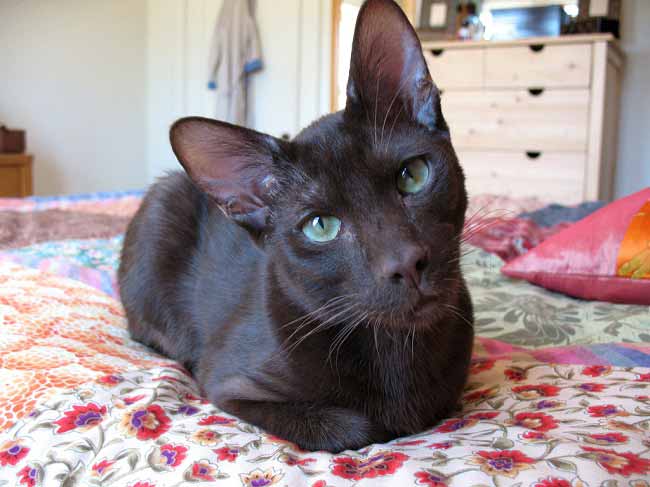
The photo shows what a Sokoke looks like.

As descendants of wild cats, Sokokes come in various shades of brown tabby, from cool to warm tones. The coat should be ticked, including the black tip of the tail. Ticking and a modified classic (marbled) tabby pattern are the Sokoke’s main distinguishing features. What’s special about these cats’ coloring?
- at least one stripe around the neck, a so-called necklace, which doesn’t have to be unbroken;
- a butterfly pattern on the back, where the lines can also be broken;
- a bull’s-eye pattern with broken lines on the side, and a broken letter “M” on the forehead.
Personality

How can you tell if this breed is right for you? Sokokes are very active and talkative and love climbing on anything they can get their paws on. Their wild roots don’t let them sit still. They can always keep themselves busy playing if their owner isn’t around. If this is your first cat, or you’re used to lazy pets, this much activity may be too much for you.
At the same time, Sokokes get very attached to people and to each other. They take separations and moves extremely hard, not to mention new owners. But they don’t demand your attention or sit in your lap for long; they just follow you everywhere.
Sokokes are great for families with children. First, they’ll play together, and second, Sokokes are very tolerant when little hands grab them carelessly. They don’t use their claws; they just run away.
Care and Health

Nature intended Sokokes to live in their own small African world. That’s why these cats don’t handle cold well, though they can adapt. They may also be sensitive to various diseases that don’t occur where they come from. So this breed is best kept in a controlled environment, indoors, away from other cats.
These cats have also shown a tendency toward nervous disorders, anxiety, hysteria, meningitis, and seizures. These nervous system problems can be inherited, so don’t take a risk by buying a Sokoke from a random seller.
Sokokes live about 15 years on average. They mature early, at 8–10 months. Males may help females raise the kittens.
Caring for a Sokoke is standard: weekly brushing, cleaning the teeth and ears, and a bath once a month. Most cats of this breed love water and swim well.
Feed a Sokoke like any other cat: balanced commercial food and a proper diet. It’s important that the cat gets vitamin E and taurine, which strengthen the heart and blood vessels and improve metabolism.

How Much Does a Sokoke Kitten Cost?

Published estimates put a Sokoke kitten at about $500–$2,000, and in Europe kittens usually cost about €1,000–2,000. In reality, the Sokoke is a very rare breed that’s very hard to find, so always get a current written quote for a specific, documented kitten. The price depends on sex, pedigree, and how well the kitten meets the standard, plus transport if the kitten comes from abroad.

Where to Find Sokoke Breeders
There are very few Sokoke breeders in North America, and in some years you may not find an active one in the US at all. TICA registers the Sokoke as a Preliminary New Breed. Here’s where to start:
- TICA (The International Cat Association) breeder listings – https://tica.org/find-a-cat/find-a-cat-breeder-listings/;
- breed clubs such as the North American Sokoke Association;
- established catteries in Denmark and other European countries, which can arrange export to the US.
Be careful: since the tabby pattern also appears in other cats, some sellers pass off ordinary tabbies as rare Sokokes. Always ask for documents that connect the kitten to registered parents.